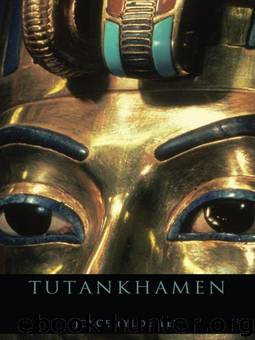
Tutankhamen: The Search for an Egyptian King by Tyldesley Joyce
Author:Tyldesley, Joyce [Tyldesley, Joyce]
Language: eng
Format: azw3
Publisher: Basic Books
Published: 2012-03-05T16:00:00+00:00
Recent Examination
Hawass’s team confirmed that Tutankhamen’s chest had suffered serious damage prior to mummification (or, less likely, during Derry’s autopsy) and that his pelvic bones were almost entirely missing. They also noted that his left thigh had been broken at, or very close to, the time of death. Their work indicated that Tutankhamen may have suffered a whole host of health problems, including a left club-foot, diseased bones in his right foot, a cleft palate, scoliosis and malaria. Many of these conclusions have been challenged; in particular, the diagnosis of the congenital abnormality club-foot (Talipes equinovarus) is open to question, as it is not unknown for ‘club-foot’ to be the result of warping caused by over-tight bandages.37 Was Tutankhamen a sickly king with mobility problems? His tomb included 130 walking sticks and canes, but the stick could also be a symbol of authority, a weapon and a piece of sporting equipment. Alongside the sticks there were armour, six chariots and an arsenal of bows and arrows, throwing sticks, slings, clubs, swords, shields and daggers. Images and artefacts from his tomb show Tutankhamen sitting to perform tasks – shooting, for example – where we might reasonably have expected him to stand, but they also show him standing to perform heroic deeds: the brave (or foolhardy?) Tutankhamen balances on a fragile papyrus boat to harpoon a hippopotamus in the marshes, or drives his chariot at speed as he chases ostriches across the desert. On his Painted Box he again stands triumphant in his chariot as he defeats his Syrian enemies. These images are conventional images of kingship. They conform to the centuries-old tradition which dictated that kings, whatever their actual appearance and character, should always appear physically perfect and brave. We have no understanding of the king behind this propaganda: we cannot state whether Tutankhamen was either brave or physically whole. Nor can we be certain that he ever tested himself on the battlefield. New kings traditionally reinforced their claim to the throne by provoking a fight with Egypt’s traditional enemies, the Nubians to the south, and the Asiatics to the north-east. Fragmented references from the Karnak, Luxor and Medamud temples suggest that Tutankhamen’s troops did campaign against both enemies, while images from the Memphite tomb of General Horemheb show Asiatics and Libyans suing for peace. However, the simple fact that the early 19th Dynasty Ramesside kings would be forced to spend many years restoring Egypt’s northern border suggests that whatever their propaganda would have us believe, and whatever campaigns they actually undertook, Tutankhamen and his successors, Ay and Horemheb, were not great generals who enjoyed multiple victories.
Download
This site does not store any files on its server. We only index and link to content provided by other sites. Please contact the content providers to delete copyright contents if any and email us, we'll remove relevant links or contents immediately.
| Africa | Asia |
| Canadian | Europe |
| Holocaust | Latin America |
| Middle East | United States |
Fanny Burney by Claire Harman(26661)
Empire of the Sikhs by Patwant Singh(23135)
Out of India by Michael Foss(16986)
Leonardo da Vinci by Walter Isaacson(13411)
Small Great Things by Jodi Picoult(7228)
The Six Wives Of Henry VIII (WOMEN IN HISTORY) by Fraser Antonia(5558)
The Wind in My Hair by Masih Alinejad(5139)
A Higher Loyalty: Truth, Lies, and Leadership by James Comey(5017)
The Crown by Robert Lacey(4862)
The Lonely City by Olivia Laing(4841)
Millionaire: The Philanderer, Gambler, and Duelist Who Invented Modern Finance by Janet Gleeson(4538)
The Iron Duke by The Iron Duke(4405)
Papillon (English) by Henri Charrière(4322)
Sticky Fingers by Joe Hagan(4255)
Joan of Arc by Mary Gordon(4156)
Alive: The Story of the Andes Survivors by Piers Paul Read(4077)
Stalin by Stephen Kotkin(4006)
Aleister Crowley: The Biography by Tobias Churton(3671)
Ants Among Elephants by Sujatha Gidla(3494)
